

Beyond the Ideal Gas Law: Selecting the Right Equation of State
Before any equation of state can be applied, it is essential to understand the fundamental physical properties that govern fluid behavior. Fluids are characterized by measurable thermodynamic variables such as pressure, volume, temperature, density, and heat capacity, all of which describe the macroscopic state of a substance and drive the majority of engineering design decisions. These properties, however, are not independent phenomena; they emerge directly from intermolecular forces such as Van der Waals attractions, dipole-dipole interactions, and hydrogen bonding, which govern how molecules pack together and exchange energy.
Simple models like the ideal gas law ignore these interactions entirely, producing fast but often inaccurate results, particularly at high pressures or low temperatures. It is this gap between idealized assumptions and physical reality that makes equations of state indispensable, as they encode molecular behavior into mathematical frameworks capable of accurately predicting how real fluids respond across a wide range of conditions.
In various fields of engineering, the ability to predict gas-phase thermodynamic and transport behavior like density, heat capacity, thermal conductivity isn’t just an arbitrary tool used without foresight; it is a key tool that engineers all over the world use to design entire systems and conduct amazing research. Equations of state (EOS) effectively act as the bridge between measurable physical properties such as density, volume, and temperature, and the intermolecular interactions of molecules. When choosing an adequate EOS, engineers must consider a plethora of complex factors to keep theoretical calculations in line with physical realities.
Failure to match the mathematical model to the design application can lead to catastrophic results, such as a 30% change in the minimum approach temperature of a heat exchanger resulting from a mere 1% deviation in the calculated density value, a finding demonstrated in a simulated liquefied natural gas system, where a 1% reduction in refrigerant flowrate, equivalent to a 1% density uncertainty, caused the pinch point temperature difference to drop from 4.1 K to 2.9 K (Al Ghafri et al., 2021).
The historical development of equations of state started with basic algebraic models, from which came the famous ideal gas law, which treats gas molecules as point particles with no intermolecular forces. Nowadays, the ideal gas law is primarily a tool for students because, while it is a fast and easy way to calculate gas properties, the accuracy isn’t sufficient for most modern engineering tasks, the model fails at high pressures and low temperatures where molecules are forced into close enough proximity that intermolecular forces become significant. The extent of this breakdown can be quantified using the compressibility factor Z (Z = PV/nRT), a correction term built on the ideal gas law itself where Z = 1 represents perfectly ideal behavior; the further Z strays from 1, the more the real gas deviates from what the ideal gas law would predict.
To remedy the shortcomings of simple algebraic equations, scientists such as Van der Waals, Soave-Redlich-Kwong, and Peng-Robinson developed their own forms of EOS, later classified as cubic (polynomial). These models are the perfect middle ground for simulation capabilities, as they are more accurate in most applications but aren’t too computationally expensive to run, taking only 43% more wall-time to get results (Rasmussen et al., 2021).
As research demands higher accuracy, engineers often rely on more modern EOS, such as series-based and empirical equations, conducive to better results. Virial equations provide a rigorous mathematical foundation by expanding thermodynamic properties in a power series of density, making them highly accurate for low-to-moderate gas densities. In contrast to virial equations, empirical methods rely heavily on extensive experimental data to fit specific parameters.
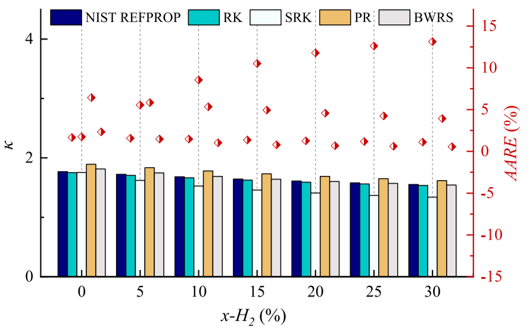
Although these models lack a physics-based understanding of gases, the accuracy provided for well-documented gases is truly hard to beat. When comparing the Soave-Benedict-Webb-Rubin (BWRS) multi-parameter equation of state to the Soave-Redlich-Kwong (SRK) cubic equation for hydrogen-blended natural gas, the BWRS equation maintained an average relative error below 2% for specific heat ratio calculations, while the SRK equation’s error reached up to 13% at a hydrogen mole fraction of 30% (Wang et al., 2024).
For complex gases involving molecular association or non-spherical shapes, more advanced categories are required. Statistical mechanics-based and fundamental equations, often based on Helmholtz energy (‘useful’ work from a closed system), are often considered the best when it comes to pure accuracy. For instance, the Span-Wagner Non-Polar EOS (a fundamental EOS) was able to achieve a <0.1% average deviation for its theoretical values of density compared to experimental data for ethylene (Sun & Ely, 2004).
While they are very accurate, the downside of these types of equations of state is that they are often not viable due to the sheer computational power necessary to get results, often barring their usage outside of research. At the theoretical frontier of equations of state, you have statistical equations such as Perturbed-Chain Statistical Associating Fluid Theory (PC-SAFT), which outperform cubic equations in predicting derivative properties by a factor of up to 8 (Vidal et al., 2018).
In my experience, equations of state can be classified into three primary categories: virial, polynomial, and multiparametric. The following table outlines when it is recommended to use each type, along with their respective advantages and disadvantages when applied to scientific and engineering calculations.
| Class | Recommended Usage | Key Advantages | Major Disadvantages |
| Polynomial | General engineering and simple pipeline systems. | Balanced accuracy and speed; only 43% more wall-time than basic models (Rasmussen et al., 2021). | Inaccurate at high pressures or low temperatures. |
| Virial | Systems with low-to-moderate gas densities. | Built on a rigorous mathematical power series of density. | Accuracy is limited strictly to lower density ranges. |
| Multiparametric | High-precision research and complex molecular associations. | Superior accuracy; can outperform cubic models by a factor of 8 (Vidal et al., 2018). | Extremely high computational cost; often not viable outside research. |
The ultimate decision when choosing an EOS rests on the optimization of simplicity, physical foundation, and accuracy. While a statistical mechanics-based equation offers the most accurate scientific data, it may be unnecessary for a quick calculation to see the viability of a simple pipeline system; conversely, a simple algebraic equation wouldn’t be sufficient for a complex hydrocarbon capture system. The best selection is whichever equation minimizes the deviation to a safe threshold while maximizing computational speed, ensuring that the result is both safe and viable.
References
- Al Ghafri, S. Z. S., Jiao, F., Hughes, T. J., Arami-Niya, A., Yang, X., Siahvashi, A., Karimi, A., & May, E. F. (2021). Natural gas density measurements and the impact of accuracy on process design. Fuel, 304, 121395.
- Rasmussen, E., Yellapantula, S., & Martin, M. J. (2021). How equation of state selection impacts accuracy near the critical point: Forced convection supercritical CO2 flow over a cylinder.The Journal of Supercritical Fluids, 171, 105141. https://doi.org/10.1016/j.supflu.2020.105141
- Sun, L., & Ely, J. F. (2004). Universal equation of state for engineering application: algorithm and application to non-polar and polar fluids.Fluid Phase Equilibria, 222-223, 107–118. https://doi.org/10.1016/j.fluid.2004.06.028
- Vidal, A., Rodriguez, C., Phoevos Koukouvinis, Manolis Gavaises, & McHugh, M. A. (2018). Modelling of Diesel fuel properties through its surrogates using Perturbed-Chain, Statistical Associating Fluid Theory. International Journal of Engine Research, 21(7), 1118–1133. https://doi.org/10.1177/1468087418801712
- Wang, J., Ouyang, X., Cheng, L., Peng, S., Wang, Z., & Wang, J. (2024). Investigation on adaptability of physical property state equation model for hydrogen-blended natural gas.International Journal of Hydrogen Energy, 81, 1256–1277. https://doi.org/10.1016/j.ijhydene.2024.07.335
Author
Felix Viau
Mechanical Engineering student at Universidad de las Americas Puebla.
Contact: felix.viaulm@udlap.mx