

Mexico’s Tourism Growth: Economic Success or Dangerous Dependence?
Mexico’s tourism showed tremendous growth in 2024. However, the data reveals deeper structural risks. Such risks become evident as we observed a strong dependence on a few markets and destinations that threaten Mexico’s resilience in tourism. The data makes it clear that Mexico’s challenge is no longer attracting tourists but reducing dependence. The future goal for Mexican tourism is its diversification because of its tendency to heavily rely on North American market. This is an economic opportunity, but it could also be a strategic risk. Figure 1 explains the top source markets to Mexico in 2024 based on international air arrivals. The graph explains how Mexican tourism is dependent on US (63.4%) and Canadian (11.8%) markets.
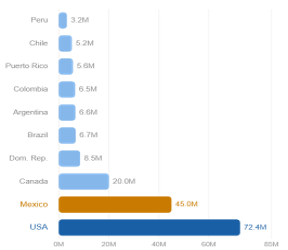
The focus on this market is favorable due to its geographical proximity and excellent air connectivity with Mexico. However, at the same time, it poses a risk for the country. If there is a decline in the demand for travel from the US or Canada, there may be an impact on Mexico’s tourism results.
Is the Pueblo Mágico program effective?
Next, figure 2 raises concerns about tourism within Mexico; how the concentration of tourist arrivals is limited to a few destinations, leaving many regions behind. While Cancun, Riviera Maya, Los Cabos, and Mexico City benefit from the international tourism, other destinations do not, despite their cultural and natural potential (Gómez Vega et al, 2025). This raises the question about the effectiveness of regional tourism development strategies such as the Pueblos Mágicos program.
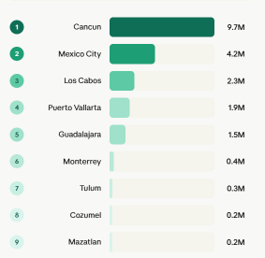
The dominance of beach destinations suggests visibility, air connectivity, and infrastructure are extremely important in making any destination successful attracting international visitors. This dilemma leaves the Pueblos Mágicos program continuing to depend primarily on domestic tourism rather than benefiting from international tourism growth. The unequal distribution of tourism flows raises an important policy question: Is Mexico developing tourism nationwide, or simply strengthening already dominant destinations? For example, how a single destination such as Cancun is not only a tourism destination, but it also acts as a tourism gateway for Mexico. Cancun contributes 43.6% to international air arrivals from main airports, hence why its performance has a direct effect on the country’s tourism figures. Mexico City and Los Cabos are other gateways with importance, but Cancun still stands out as an excellent illustration of how infrastructure, air connectivity, hotel capacity and branding influence the nation’s tourism performance.
Tourism expenditure in Mexico
The data on monthly tourism expenditure by international air tourists for the years 2024 and 2023 shows that the expenditure increased roughly to $27.0 billion for 2024. There has been an increase of 5.2% increase from the $25.7 billion recorded in 2023- also the average expenditure per trip was also up by 3.6%. Mexico, therefore, is not only attracting more tourists, but also generating greater revenue hinting at higher-value tourism that is essential for contributing to the country’s tourism revenue and economic resilience.
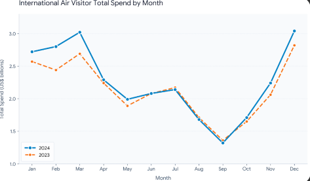
This graph is significant since it changes the debate from quantity to quality. While international air traffic was up by just 2.0% in number, expenditure increased even faster. For policymakers, this means that Mexico has not just been able to attract more tourists but also derive more value from them.
Conclusion
The article explains the economic success of Mexico’s tourism growth in 2024 and its dependence on certain markets. Since most of the tourism activities are based in beach areas such as Cancun and Riviera Maya that have good air connectivity and infrastructure, there is a need for data driven strategy to ensure other regions also benefit from tourism. Therefore, there is a need to improve tourism infrastructure, connectivity and visibility of such areas in international markets. Diversification is necessary, particularly in China, Japan, South Korea, and Argentina. Lastly, a more sustainable and regionally inclusive tourism sector necessitates data-driven planning and tourism intelligence.
References
- Economía y Sectores Productivos. INEGI. (2026). https://en.www.inegi.org.mx/temas/turismo/
- Gómez Vega, M., Valdivia, M., & Alonso Villa, P. (2025). Eficiencia Turística en los estados mexicanos según el origen de los visitantes: Explorando El Papel Estratégico de los recursos culturales. Paradigma Económico, 17(3), 235. https://doi.org/10.36677/paradigmaeconomico.v17i3.26864
- Statista Research Department, & 29, N. (2025). Foreign Air Travelers’ origin countries Mexico 2024. https://www.statista.com/statistics/663179/leading-source-countries-for-international-tourists-mexico/
Authors
Guadalupe Ramírez Rodríguez
Contact: guadalupe.ramirezrz@udlap.mx
Vinicio Rainer Elizalde Hernández
Contact: vinicio.elizaldehz@udlap.mx
Luis Enrique Sánchez López
Contact: luis.sanchezlz@udlap.mx
Mentor
Dr. Tahir Iqbal Sufi
Doctor en Administración de Empresas por la IKG Punjab Technical University, Maestro en Gestión de la Hospitalidad por la Sheffield Hallam University y Licenciado en Artes por la Osmania University. Cuenta con más de 20 años de experiencia académica y en la industria de la hospitalidad, con trayectoria en instituciones académicas y marcas como Le Méridien, Hilton y Best Western. Desde 2023, es profesor de tiempo completo en el Departamento de Turismo de la Escuela de Negocios y Economía de la Universidad de las Américas Puebla.
Contact: tahir.sufi@udlap.mx